Checked November 5, 2026 · U.S. health-insurance education
Keep the worksheet beside the episode.
Page one follows Penny’s claim and annual limit. Page two gives you a checklist for comparing an Explanation of Benefits (EOB), a provider bill and your payment records.
Download and print it, or annotate your own copy. Keep completed worksheets and medical documents private. This page does not ask you to upload them or enter health information.
The four amounts that do different jobs
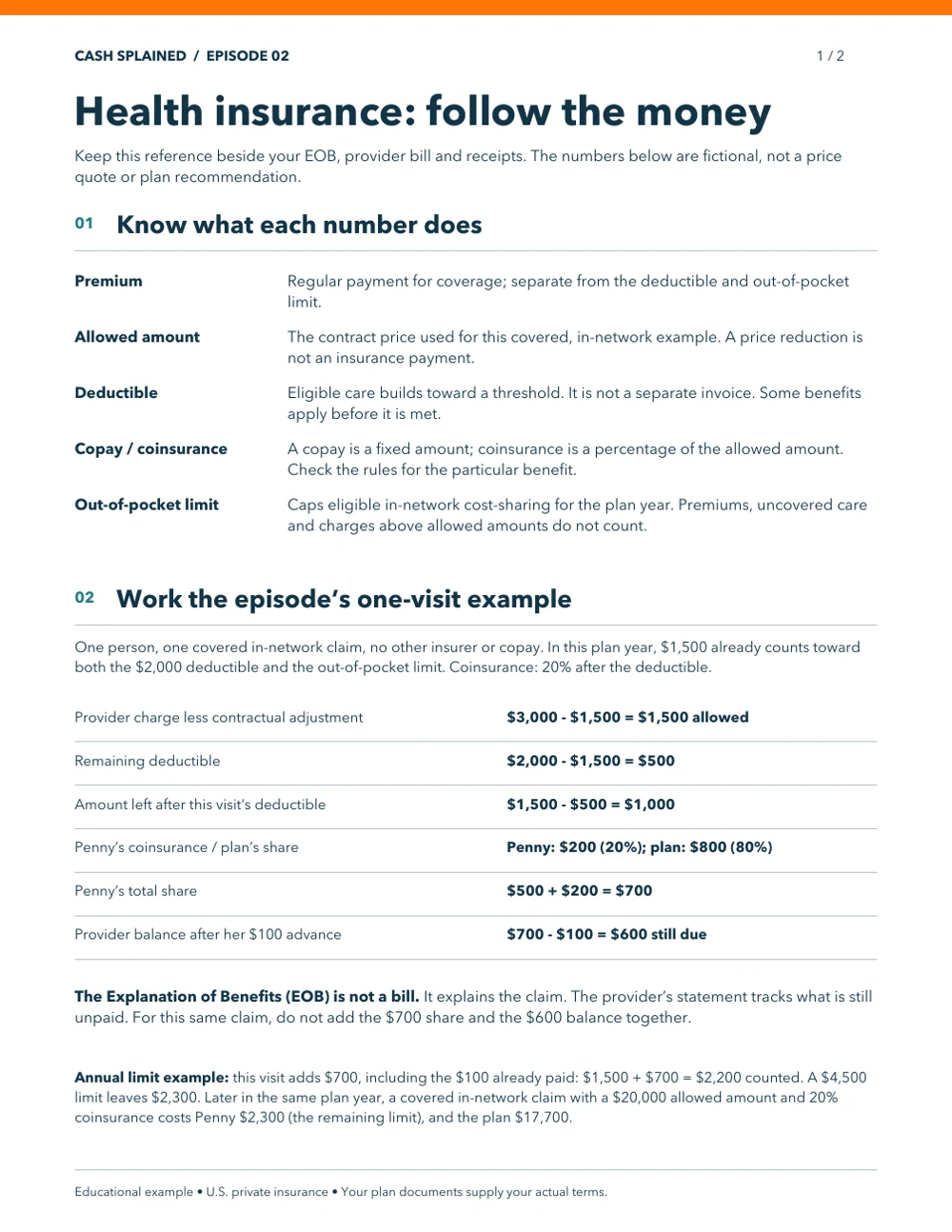
- Premium
- The recurring price of coverage. Paying it does not mean every service is free, and it does not count toward the deductible or out-of-pocket limit.
- Deductible
- The amount you pay for certain covered services before the plan starts sharing those costs. Some benefits work before the deductible; plans can have separate deductibles.
- Copay and coinsurance
- A copay is a fixed amount. Coinsurance is a percentage of the allowed amount. Check when each applies to the particular benefit.
- Out-of-pocket limit
- A plan-year cap on eligible in-network cost-sharing. Premiums, uncovered care, out-of-network care and charges above the allowed amount do not count toward this limit. Check your plan’s terms and any separate limits.
One claim. Every dollar accounted for.
This illustration follows one person and one covered in-network claim, with no other insurer or copay. In the same plan year, $1,500 already counts toward both Penny’s $2,000 deductible and her out-of-pocket limit. Her coinsurance is 20% after the deductible.
| Step | Amount |
|---|---|
| Provider’s original charge | $3,000 |
| In-network adjustment | − $1,500 |
| Allowed amount | $1,500 |
| Penny’s remaining deductible | $2,000 − $1,500 = $500 |
| Amount left after the deductible | $1,500 − $500 = $1,000 |
| Penny’s coinsurance | 20% × $1,000 = $200 |
| Plan’s payment | 80% × $1,000 = $800 |
| Penny’s total share | $500 + $200 = $700 |
| Payment already credited by the provider | − $100 |
| Penny’s remaining bill | $600 |
The $800 plan payment plus Penny’s $700 share equals the $1,500 allowed amount. Her $100 advance payment is part of that $700, so it reduces what she still owes the provider to $600. It is not an extra $100 of cost-sharing.
What happens later in the plan year?
This visit brings Penny’s eligible total to $1,500 + $700 = $2,200. Against the example’s $4,500 out-of-pocket limit, she has $2,300 left.
For a later covered in-network claim in that same plan year, assume a $20,000 allowed amount, the deductible already met and 20% coinsurance. Twenty percent would be $4,000, but only $2,300 remains before her limit. Penny pays $2,300 and the plan pays $17,700. This does not make premiums or uncovered services free.
An EOB is a plan record. A bill asks for payment.
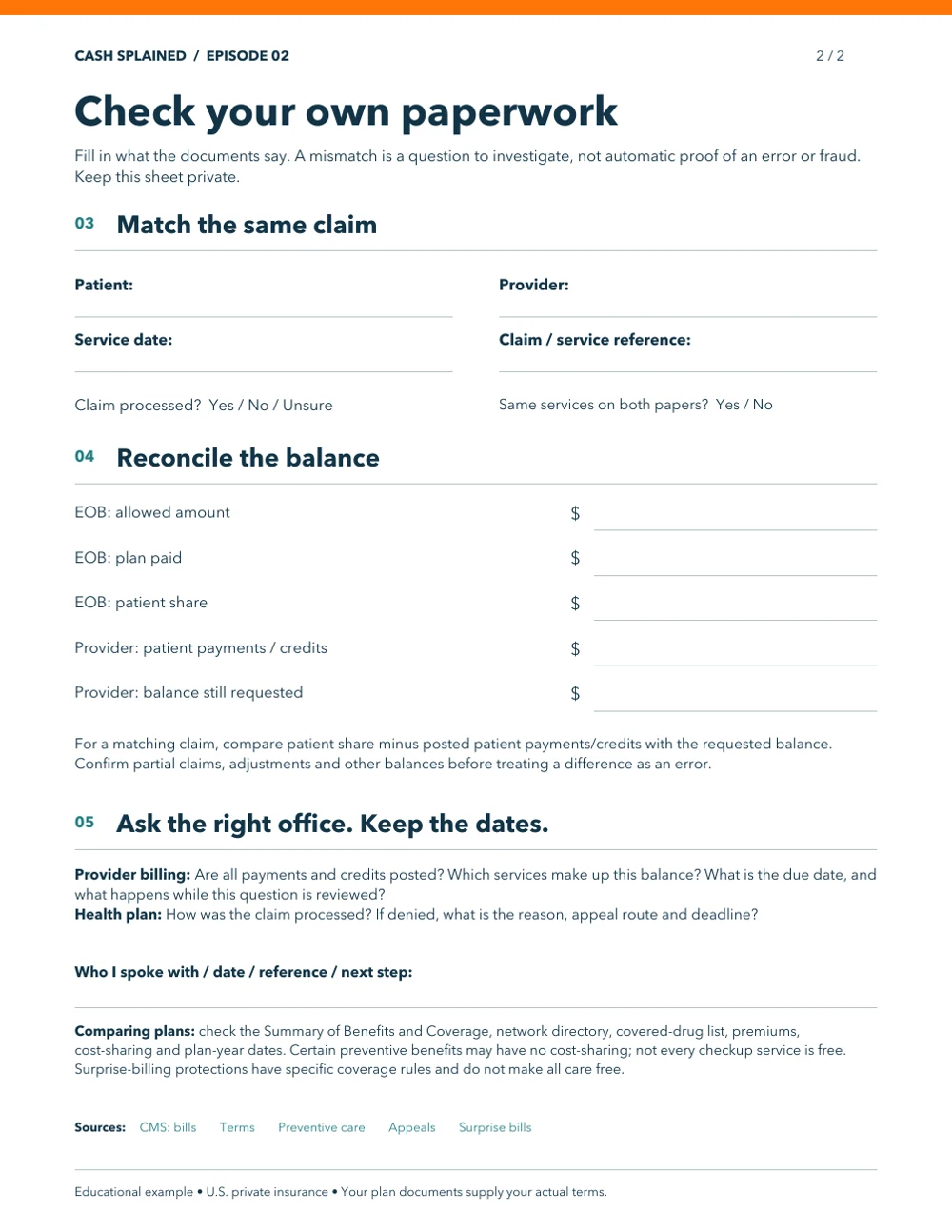
- Match the patient, provider, service dates and claim reference. Check that the claim is processed and covers the same services.
- Find the allowed amount, the plan payment and patient responsibility on the EOB.
- Check payments and credits already posted by the provider. They may not be deducted on the EOB.
- Compare the remaining balance. Before calling it an error, check for partial claims, later adjustments or other balances.
- Ask the billing office to explain the difference, confirm posted payments and discuss the due date while the bill is reviewed. Ask your plan about processing, denials and appeal deadlines.
Check the benefit, not just the insurance card.
Use the Summary of Benefits and Coverage, provider directory, drug list and full plan terms. Certain preventive services are generally covered without cost-sharing in network, subject to applicable rules; that does not make every checkup or service free. Federal surprise-billing protections apply to specified situations, not every unexpected bill.
Sources and limits
These primary sources support the explanations. The dollar amounts are an illustrative scenario, not a quote for any particular plan.
- CMS: How to read an Explanation of Benefits ↗
- HealthCare.gov: Deductible ↗
- HealthCare.gov: Out-of-pocket maximum ↗
- HealthCare.gov: Summary of Benefits and Coverage ↗
- HealthCare.gov: Preventive care benefits ↗
- CMS: Surprise medical bills and your rights ↗
- HealthCare.gov: Appealing a plan decision ↗
General education, not individualized insurance, medical or legal advice. Actual coverage, cost-sharing and appeal procedures depend on your plan and applicable rules. Keep personal medical and billing information out of public comments.